By Rick | rentinholland.nl | Last updated: April 2026
The Huurcommissie (Rent Tribunal) is one of the most powerful tools available to tenants in the Netherlands, yet most expats have never heard of it. A Huurcommissie complaint can save you hundreds of euros and lead to a legally binding decision in your favour. If your rent is too high, your landlord is neglecting maintenance, or you have received an unfair rent increase, the Huurcommissie can step in and make a legally binding decision. The filing fee is just 25 euro, you do not need a lawyer. Here is exactly how it works.
Having seen the Huurcommissie process from both sides over the years, I can tell you that it is a fair and effective system. Many tenants hesitate to use it because they do not know how it works or are afraid of the consequences. This guide will take away that uncertainty and walk you through the entire process. If you are not yet familiar with your tenant rights in the Netherlands, I recommend reading that guide first.
What Is the Huurcommissie?
The Huurcommissie is an independent government body that resolves disputes between tenants and landlords. It is not a court, but its decisions are legally binding unless either party appeals to the kantonrechter (subdistrict court) within eight weeks.
The Huurcommissie handles disputes about rent prices (is your rent above the legal maximum?), service charges (are the costs fair and transparent?), maintenance issues (is your landlord neglecting repairs?), rent increases (is the proposed increase legal?), and landlord behaviour in the free sector.
It is completely separate from your landlord, your municipality, and any housing corporation. Their job is to assess the facts and make an impartial decision.
When Should You File a Huurcommissie Complaint?
You can file a complaint with the Huurcommissie in several situations.
Your initial rent is too high. If you believe the rent you agreed to at the start of your contract exceeds the legal maximum based on the WWS points system, you can ask the Huurcommissie to assess the correct rent. This is especially relevant if your home scores fewer than 187 WWS points. Want to check this first? Use our guide on how to check if your rent is too high.
Your rent increase is unreasonable. In 2026, the maximum rent increase is 4.1 percent for social housing and 6.1 percent for mid-range rentals. If your landlord proposes more than this, you can challenge it through the Huurcommissie.
Want to know the exact rules? Our rent increase guide explains the maximum percentages and how to object.
Your landlord is not maintaining the property. If there are serious maintenance issues (think leaks, broken heating, mould, structural problems) and your landlord refuses to fix them despite written requests, the Huurcommissie can order repairs and even temporarily reduce your rent until the issues are resolved.
Your service charges are unclear or too high. Your landlord must provide an annual breakdown of service charges. If they refuse, or if the charges seem unreasonable, the Huurcommissie can review them.
The Huurcommissie also handles disputes about service charges. If your landlord overcharges you or fails to provide an annual statement, you can file a complaint. Learn more in our guide on service charges in the Netherlands.
Your landlord’s behaviour is problematic (free sector only). Since 2023, tenants in the free sector can file a complaint about their landlord’s behaviour, such as intimidation, refusing to carry out agreed repairs, or withholding the rental deposit without justification.
Working in English: What to Expect
Before we walk through the steps, one thing every expat tenant should know upfront. The Huurcommissie is a Dutch government body, and the official procedure is conducted in Dutch. All letters, the case file, and the hearing itself are in Dutch. The Huurcommissie does not provide English-speaking support staff and does not arrange interpreters for you. Setting that expectation correctly will save you a lot of frustration later.
That does not mean you cannot use the Huurcommissie if you do not speak Dutch. There are several openings.
First, attachments to your case (such as your rental contract, photos, or correspondence with your landlord) may be submitted in English, German, or French without translation, unless the Huurcommissie specifically asks for one. So your evidence does not need to be translated by default.
Second, you are allowed to bring a translator to the hearing. This does not have to be a sworn or registered interpreter. A friend, colleague, or family member who speaks both Dutch and English can sit next to you and translate. The cost, however, is yours: the Huurcommissie does not reimburse interpreters.
Third, in exceptional cases the chairperson of the hearing can decide that some questions and answers may be in English, provided the other party has no objection. This is not a right you can claim, and it should not be your plan A. Treat it as a small possibility, not a guarantee.
Finally, the Huurcommissie’s online Rent Check tool is available in English since late 2024. That is currently the only Huurcommissie-tool that has been formally translated.
This is exactly why this site, and our templates, exist. Our letter templates give you the correct Dutch text to submit, with a full English translation and step-by-step instructions in English so you understand precisely what you are filing. For live communication, English-speaking tenant support is available through Huurteam, !WOON (in Amsterdam), and Juridisch Loket. Combine these and you can run a Huurcommissie procedure with confidence, even without speaking the language.
👉 Huurcommissie Complaint Letter Template Need help writing your complaint letter? Our template includes a formal Dutch complaint letter ready to send, full English translations, a pre-written request for rent assessment, and a complete attachments checklist. View on Etsy
What You Need Before Filing
Preparation is key. Before you file a complaint, make sure you have the following ready.
Before filing your complaint, review your lease with our Dutch rental contract checklist to make sure you have all the details you need.
Written communication with your landlord. The Huurcommissie expects you to have tried to resolve the issue directly with your landlord first. Send your landlord an email or letter clearly describing the problem and what you want them to do about it. Keep a copy of everything. If your landlord does not respond or refuses to cooperate, you have a strong basis for your complaint.
Your rental contract. You will need to provide a copy of your lease agreement. Make sure you have a digital version ready.
Evidence of the issue. Depending on your complaint, this could be photos of maintenance problems, a copy of your service charge statement, the rent increase letter from your landlord, or your own WWS points calculation using the Huurprijscheck tool at huurcommissie.nl.
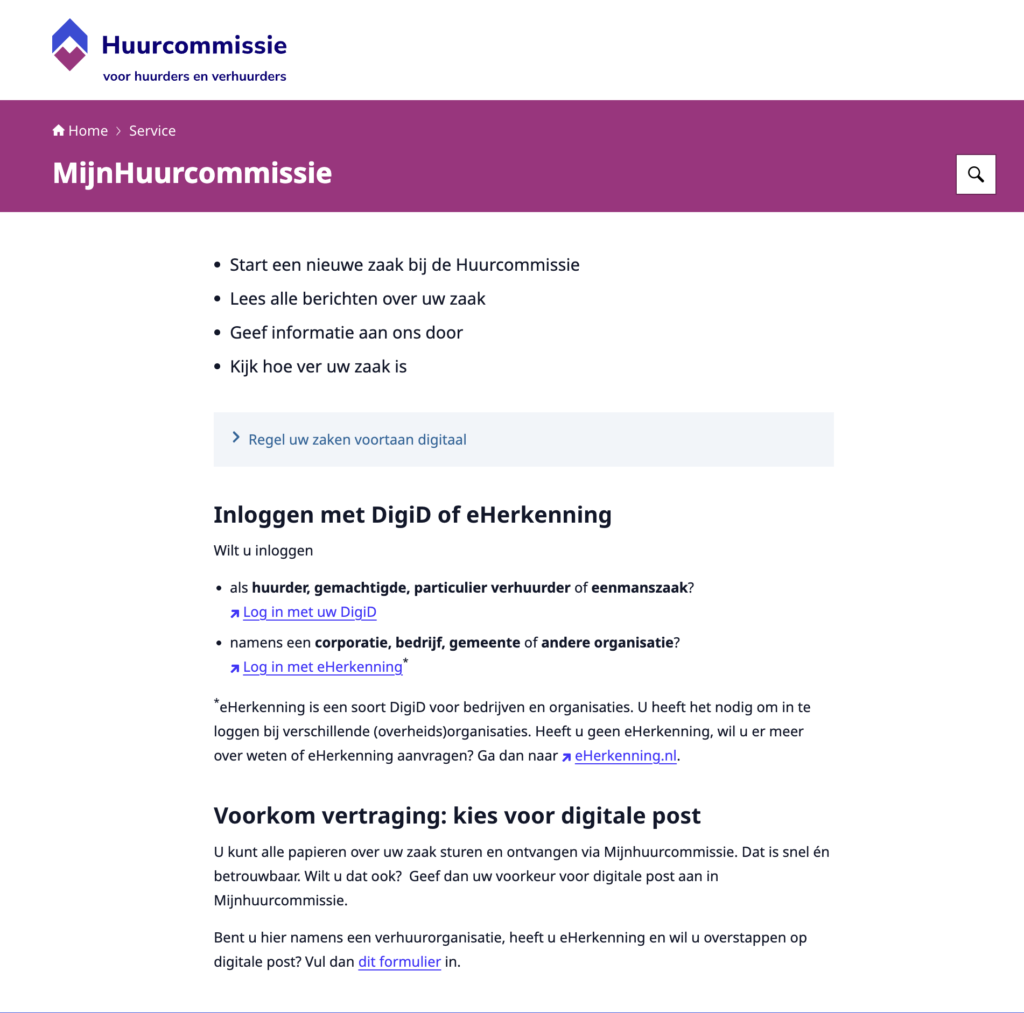
Your DigiD (if you have one). The easiest way to file is through MijnHuurcommissie, the online portal, which requires DigiD login. If you are an expat without DigiD, do not worry, there are alternatives (more on that below).
The Filing Process: Step by Step
Here is exactly how to file a complaint with the Huurcommissie.
Step 1: File Your Complaint Online or by Post
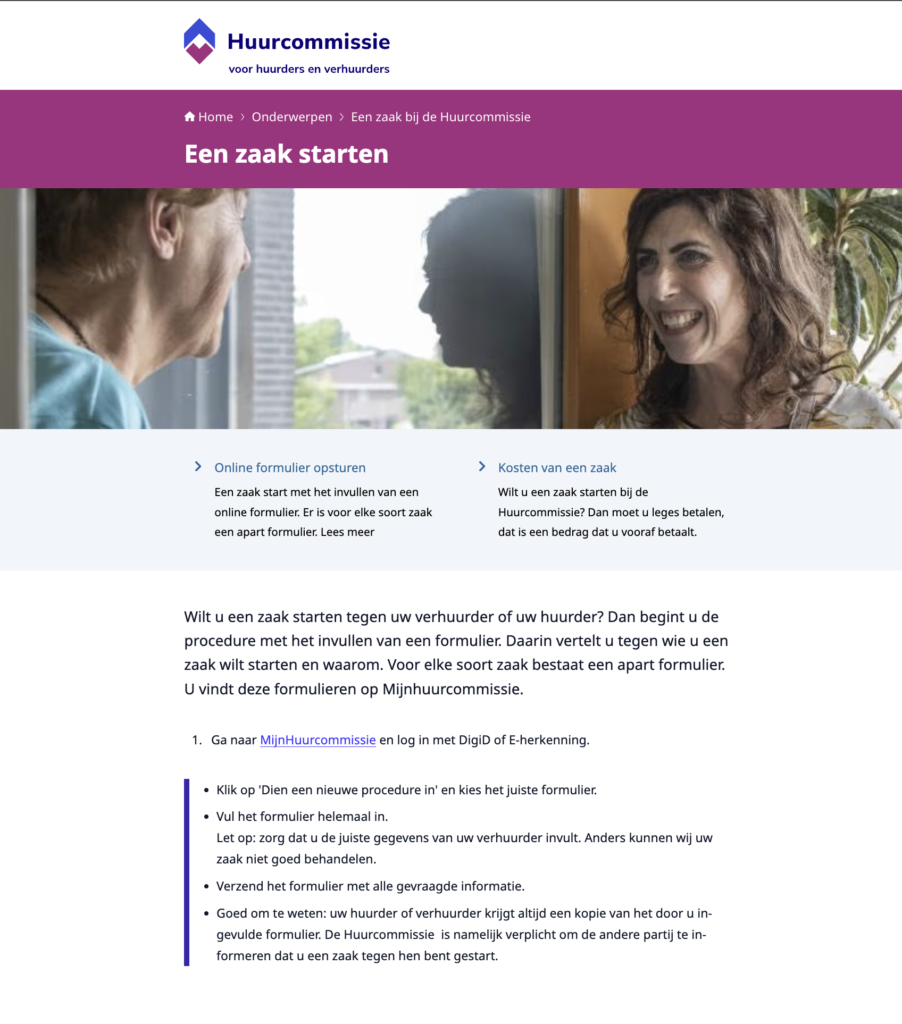
If you have DigiD: Go to mijnhuurcommissie.nl, log in with your DigiD, and select “Dien nieuwe procedure in” (File new procedure). Follow the prompts and fill in the details of your complaint. You can upload supporting documents directly.
If you do not have DigiD: You can file by sending a letter to the Huurcommissie by post. The letter should include your name and address, your landlord’s name and address, a description of the problem, what you want the Huurcommissie to do, and copies of relevant documents. Send it to: Huurcommissie, Postbus 16495, 2500 BL Den Haag. Note that the letter must be written in Dutch. If you need help with this, consider asking a Dutch-speaking friend or using a translation service.
Step 2: Pay the Filing Fee
The filing fee is 25 euro for tenants. You will receive payment instructions after submitting your complaint. If the Huurcommissie rules in your favour, your landlord will be required to reimburse this fee.
Step 3: Your Landlord Responds
After you file, the Huurcommissie notifies your landlord, who gets 30 days to submit their response and any evidence. You will receive a copy of their response.
Step 4: Property Inspection (If Applicable)
For complaints about rent prices or maintenance, the Huurcommissie typically sends a rapporteur (inspector) to visit your property. You will be notified of the date in advance. Make sure you are present during the visit. The inspector will assess the condition of the property, count WWS points, and document any issues. This inspection forms the basis of the Huurcommissie’s decision, so it is important to prepare: make sure all problems are visible and have your documents ready.
Step 5: The Hearing
After the inspection, a hearing (zitting) is scheduled. Both you and your landlord are invited to present your case. You can attend in person or, in some cases, by video conference. You do not need a lawyer, but you are allowed to bring someone for support, such as a friend, family member, or advisor. The hearing is your chance to explain your side and respond to your landlord’s arguments.
Step 6: The Decision
The Huurcommissie issues a written decision (uitspraak) that is sent to both parties. The decision specifies the correct WWS points, the correct maximum rent, and any actions the landlord must take (such as lowering the rent or carrying out repairs). This decision is legally binding. If either party disagrees, they can appeal to the kantonrechter within eight weeks.
How Long Does the Process Take?
The entire process typically takes four to six months from filing to decision. The legal maximum is 26 weeks. The actual timeline depends on the complexity of your case and the Huurcommissie’s workload. Rent price assessments tend to be faster than maintenance disputes, which require more extensive inspections.
During this period, you should continue paying your rent as normal. Do not withhold rent while waiting for the decision, as this could weaken your position.
What Happens After the Decision?
If the Huurcommissie rules in your favour, your landlord must comply with the decision. If the Huurcommissie determines that your rent was too high, your landlord must lower it and, in some cases, refund the overpaid amount. The exact refund depends on when you filed and the specifics of your case.
If your landlord ignores the decision, you can take it to the kantonrechter to enforce it. This rarely happens in practice, as most landlords comply with Huurcommissie rulings.
If you disagree with the decision, you can appeal to the kantonrechter within eight weeks. The same applies to your landlord. Keep in mind that going to court involves higher costs and longer timelines, so it is worth considering whether the outcome of the appeal is likely to be significantly different.
Common Concerns Expats Have
“Will my landlord evict me for filing a complaint?” No. Dutch law strongly protects tenants against retaliatory eviction. Your landlord cannot terminate your lease because you filed a complaint with the Huurcommissie. If your landlord tries to pressure you, that is itself a violation that can be reported.
“I do not speak Dutch. Can I still use the Huurcommissie?”
Yes, you can. As explained in ‘Working in English: What to Expect’ earlier in this guide, the official procedure is conducted in Dutch, but there are several practical openings: English-language attachments are accepted, you may bring your own translator to the hearing, and English-speaking tenant support is available through Huurteam, !WOON, and Juridisch Loket. Our complaint letter template gives you the exact Dutch text you need to file, with full English translations and instructions, so language never blocks a valid complaint.
“I do not have DigiD. What do I do?” If you have a BSN (citizen service number), you can apply for DigiD at digid.nl. It takes about a week to receive your activation code by post. If you cannot get DigiD, use the postal option described above.
“What if my home is in the free sector?” For properties scoring 187 or more WWS points, the Huurcommissie’s role is more limited. You cannot challenge the initial rent price, but you can still file complaints about service charges, maintenance issues, and landlord behaviour.
“Is 25 euro really all it costs?” Yes. The filing fee is 25 euro for tenants. You do not need to hire a lawyer, and there are no other mandatory costs. If you win, your landlord pays the 25 euro. It is one of the most accessible dispute resolution systems in Europe.
Tips for a Successful Complaint
From years of experience in the Dutch housing industry, here are my tips for getting the best outcome.
Document everything from day one. Keep copies of your contract, all communication with your landlord, rent payment receipts, and photos of any issues. The more evidence you have, the stronger your case.
Try to resolve it directly first. The Huurcommissie appreciates it when tenants have made a genuine effort to resolve the issue with their landlord before filing. Send a clear, polite email or letter first and give your landlord a reasonable deadline to respond.
Be accurate with the Huurprijscheck. If your complaint is about rent, use the Huurprijscheck tool on the Huurcommissie website to get an indication of your home’s WWS points before filing. This helps you understand whether you have a strong case.
Be present for the inspection. If a rapporteur visits your property, make sure you are there. Point out any issues, answer their questions honestly, and have your documents ready.
Stay calm and factual at the hearing. The hearing is not a courtroom drama. Present your facts clearly, stick to the evidence, and remain respectful. The Huurcommissie values objective information over emotional arguments. Trust the process. A well-prepared Huurcommissie complaint rarely fails when you have the evidence on your side.
Final Thoughts
The Huurcommissie exists to protect tenants, and it does this job well. For 25 euro and a few hours of your time, you can get an independent, legally binding assessment of your rental situation. Whether your rent is too high, your landlord is neglecting maintenance, or you have received an unfair rent increase, the Huurcommissie is there to help.
Do not let fear or unfamiliarity stop you from using it. Thousands of tenants file complaints every year, and the system is designed to be accessible, even for expats who are new to the Netherlands.
Having trouble getting your deposit back? That is another common issue. Read our rental deposit guide for the exact steps to take.
Rick is a housing expert based in the Netherlands with years of hands-on experience in property management. He created rentinholland.nl to help expats navigate the Dutch rental market with confidence.
Related Articles
- Tenant Rights in the Netherlands: Complete Expat Guide (2026)
- Is Your Rent Too High? How to Check in the Netherlands
- Service Charges in the Netherlands: What Tenants Need to Know
- Rental Deposit Rules in the Netherlands
- Rent Increases in the Netherlands: What Tenants Need to Know
- Dutch Rental Contract Checklist: What Every Expat Must Check
- The Affordable Rent Act: New Dutch Rental Law (2026)
Frequently asked questions
What is the Huurcommissie?
An independent Dutch body that settles disputes between tenants and landlords about rent, service charges, maintenance and rent increases. Its decisions are legally binding.
How much does a Huurcommissie complaint cost?
A filing fee of 25 euro, which you may get back if the Huurcommissie rules in your favour.
Can I deal with the Huurcommissie in English?
The official procedure is in Dutch, but the rent check and some information are available in English, and you can ask someone to help you with the paperwork.
How long does a Huurcommissie procedure take?
Usually a few months from filing to decision, depending on the type of case.
Need to take action? We have ready-made legal letter templates for expats:
👉 Rent Increase Objection Letter Template
👉 Huurcommissie Complaint Letter Template
👉 Rental Deposit Demand Letter Template
👉 Service Charge Dispute Letter Template
👉 Rental Contract Checklist Template
All templates include a formal Dutch letter, full English translations, and step-by-step instructions.
Dealing with more than one issue? The Complete Dutch Tenant Letter Kit bundles the four dispute letters (deposit, rent increase, service charges and Huurcommissie) at a lower price than buying them separately.
Useful Links
- Huurcommissie (Rent Tribunal): File complaints about service charges
- Juridisch Loket: Free legal advice (Dutch)
- Huurteam Nederland: Free tenant advice (English available)
- Government.nl, Rented Housing: Official government information
- !WOON: Free tenant support in Amsterdam (English available)