By Rick | rentinholland.nl | Last updated: September 2026
Understanding service charges Netherlands rules is essential for every tenant, yet most expats never check whether they are being charged fairly. Known as “servicekosten” in Dutch, these are additional costs that most renters pay on top of their basic rent (kale huur) every month. These charges cover things like cleaning of shared spaces, a caretaker, or energy for communal areas, and they typically range from €50 to €200 per month.
Service charges Netherlands rules are one of the most common sources of confusion and disputes between tenants and landlords, especially for expats who may not be familiar with Dutch rental law Many tenants simply pay whatever their landlord charges without realizing they have the right to question, verify, and even dispute these costs.
This guide covers everything you need to know about service charges in the Netherlands: what your landlord is (and isn’t) allowed to charge, how to read your annual statement, and what to do if you think you’re paying too much.
What Are Service Charges (Servicekosten)?
Service charges are additional costs on top of your basic rent that cover services and facilities related to your rental property. Think of it this way: your basic rent (kale huur) is the price you pay for the living space itself. Service charges cover everything else your landlord provides alongside that space.
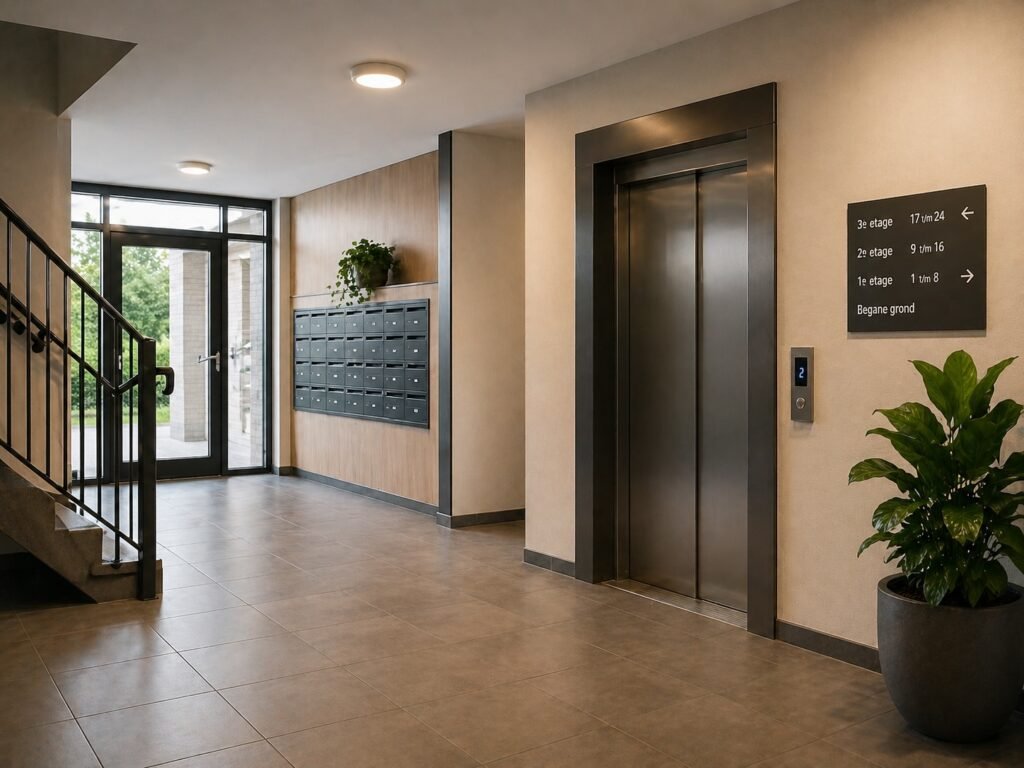
Common examples of service charges include cleaning of shared hallways, staircases, and entrances, energy costs for communal lighting and heating, caretaker or concierge services, maintenance of shared gardens and green areas, window cleaning in communal spaces, and furniture or appliances provided in shared areas.
The amount varies depending on the building and the services offered, but most tenants in the Netherlands pay somewhere between €50 and €200 per month in service charges.
Basic Rent vs. All-In Rent: Why It Matters
Your rental contract should clearly separate your basic rent (kale huur) from your service charges. This distinction is important because it determines your legal protections and whether you qualify for rent allowance (huurtoeslag).
If your contract shows just one total amount without any breakdown, you likely have an “all-in” rental price. This is actually problematic under Dutch law. As a tenant with an all-in price, you can request the Huurcommissie (Rent Tribunal) to split it. The standard split is 55% basic rent and 25% service charge advance, with the rest treated as a correction. This split almost always works in the tenant’s favor, so if you’re currently paying an all-in price, it’s worth looking into.
When reviewing your rental contract, make sure you can clearly see both your kale huur and your service charges listed as separate line items. If you can’t, that’s a red flag.
Make sure your service charges are properly listed and separated from your basic rent. Our Dutch rental contract checklist walks you through every clause step by step.
What Your Landlord Can and Cannot Charge
Dutch law sets clear boundaries on what counts as a legitimate service charge. This is one of the areas where many landlords push the limits, so it’s important to know your rights.
What CAN Be Charged as Service Costs
Your landlord may charge service costs for heating and cooling of shared spaces, electricity, gas, and water for communal areas, cleaning of common areas such as hallways, staircases, and lifts, caretaker or concierge services, maintenance and cleaning of shared gardens, window washing in communal areas, and moveable items (like furniture) provided in shared spaces.
For furniture and moveable items specifically, there is a maximum: your landlord can charge a maximum of 20% of the purchase price per year, and only for items less than five years old. After five years, the items need to be reappraised at their secondhand value.
What CANNOT Be Charged as Service Costs
Your landlord is not allowed to charge service costs for things that are considered part of the property itself. This includes built-in appliances (such as a built-in kitchen), double glazing, insulation, and structural improvements to the building. These items should be reflected in the basic rent, not in the service charges.
Additionally, luxury amenities like swimming pools and fitness facilities are explicitly excluded from service charges. If your building has these, the landlord needs to cover the costs through a different arrangement.
The Golden Rule: No Profit on Service Charges
Perhaps the most important rule: your landlord is not allowed to make a profit on service charges. Service charges must reflect the actual costs. If your landlord charges you €150 per month for cleaning but the actual cleaning costs are €80, you are being overcharged and have the right to reclaim the difference.
This is enforced through the annual statement, which we’ll cover next.
Your Annual Statement (Jaarafrekening)
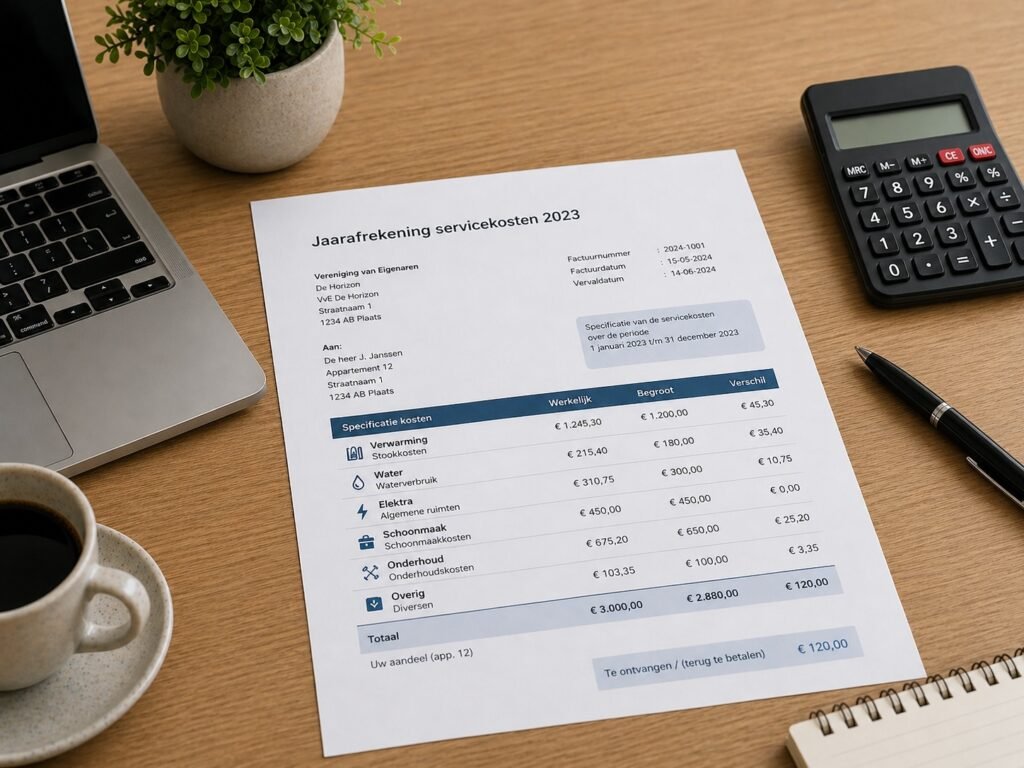
Every year, your landlord is legally required to provide you with an annual statement of your service charges. This statement, called a “jaarafrekening,” must be delivered before July 1 of the following year. So for 2025 service charges, you should receive the statement before July 1, 2026.
What the Statement Should Include
A proper annual statement should contain an itemized list of all actual costs incurred during the year, the total amount of advance payments you made, and a clear calculation showing whether you underpaid or overpaid. If you paid more in advances than the actual costs, your landlord owes you a refund. If you paid less, you may owe additional payment, but only for legitimate costs.
What If You Don’t Receive a Statement?
If your landlord fails to provide an annual statement on time, you have options. You can send a written request asking for the statement. If they still don’t provide it, you can file a complaint with the Huurcommissie. In practice, a landlord who consistently fails to provide annual statements is a serious red flag, as it often means the service charges aren’t properly substantiated.
Administrative Costs
Your landlord is allowed to charge a small administrative fee for managing the service charges. This fee is capped at 5% of the total actual service costs (excluding energy costs if you have your own meter). If your landlord charges more than this, the excess is not legitimate.
New Service Charge Rules from 1 January 2027
What Applies in 2026?
Until 31 December 2026, the current service charge rules continue to apply. Your landlord must base the annual settlement on the actual cost of the services provided. You are entitled to an itemised annual statement and may ask to inspect the invoices and receipts behind it. If the figures are incorrect or unsupported, you can challenge them.
What Changes on 1 January 2027?
The Wet modernisering servicekosten, the Modernisation of Service Charges Act, takes effect on 1 January 2027. For rental agreements starting on or after that date, landlords may only charge costs that fall within eight statutory service charge categories. The government originally planned to introduce these rules on 1 July 2026, but postponed the starting date. You can check the official government announcement and the Huurcommissie overview for the current timetable.
Some procedural improvements will also apply to existing rental agreements. These include a route to have the monthly advance assessed before the annual statement, easier handling of similar requests from groups of tenants, and standard amounts the Huurcommissie may use when a landlord does not provide a correct annual statement. The exact route depends on your contract date and the issue you want reviewed.
Enforcement
Municipalities can enforce compliance under the “Wet goed verhuurderschap” (Good Landlord Act, 2023), with penalties up to €25,750 for violations.
How to Dispute Your Service Charges
A note on language. Disputing service charges with your landlord, and any follow-up procedure at the Huurcommissie, is a Dutch-language process. You don’t need to speak Dutch to start a complaint, but your written submission must be in Dutch to be taken seriously. Our service charge dispute letter template provides the correct Dutch text, with an English translation and instructions, so the language barrier never costs you a refund you are entitled to. For additional support, organizations like Huurteam Nederland and !WOON (Amsterdam) offer free service-charge advice in English.
If you believe your service charges are too high, incorrect, or not properly substantiated, here’s what you can do.
Step 1: Check Your Annual Statement
Review the annual statement carefully. Look for costs that seem unusually high, items that shouldn’t be charged as service costs, missing documentation or invoices, and any profit margin built into the charges.
Step 2: Contact Your Landlord in Writing
Send your landlord a written objection (email or letter) specifying which costs you disagree with and why. Be specific: don’t just say “the charges are too high,” but point out exactly which line items you’re questioning. Keep a copy of all correspondence.
Step 3: File with the Huurcommissie
If your landlord doesn’t resolve the issue within a reasonable time (typically a few weeks), you can file a complaint with the Huurcommissie. Here’s what you need to know about the process:
Who can file: You do not need Dutch citizenship. For rental agreements signed on or after 1 July 2024, tenants in the social, mid-range and free sectors can ask the Huurcommissie for a binding decision about service charges. With an older free-sector agreement, the Huurcommissie can only provide advice if your contract or a separate written agreement allows this route. Check which procedure applies before filing.
Filing fee: €25, which is refunded if the decision is in your favor.
Minimum amount: The disputed amount must be at least €36.
How to file: If you have a DigiD, you can file online at mijnhuurcommissie.nl. Without DigiD (common for expats), you can file by sending a letter in Dutch to the Huurcommissie by post. Include your rental contract, the annual statement, proof of payments, and a clear description of what you’re disputing.
Timeline: The process typically takes 3 to 6 months.
Deadline: You can file up to two and a half years after the end of the calendar year the charges relate to (Article 7:260 BW). So for 2024 service charges, the deadline is June 30, 2027.
Protection: Using the Huurcommissie is your legal right. A landlord cannot end your tenancy simply because you filed a complaint. The landlord must rely on a lawful ground for termination. If you do not agree to leave, a court decides whether the tenancy can end. Keep all correspondence and seek legal help if your landlord threatens eviction after you raise a service charge dispute.
👉 Service Charge Dispute Letter Template Need a ready-made dispute letter? Our template includes a formal Dutch objection letter, full English translations, five pre-written objection reasons, and a Helpful Notes page with legal deadlines and resources. View on Etsy
Step 4: After the Huurcommissie Decision
The Huurcommissie will review the evidence. When it has authority to issue a binding decision, that decision becomes binding unless either party takes the matter to the district court (kantonrechter) within eight weeks. In an older free-sector case that the Huurcommissie handles only as an advisory procedure, the outcome is not binding. Check the procedure shown for your contract before filing.
Tips for Expats
If you’re an expat renting in the Netherlands, here are some practical tips to protect yourself when it comes to service charges.
Always ask for a breakdown of service charges before signing a rental contract. If the landlord can’t or won’t provide one, be cautious. Keep records of all payments you make, including monthly rent and service charge advances. Don’t ignore your annual statement when it arrives. Review it carefully, even if the numbers seem small, as small overcharges add up over time.
If your contract is all-in (no breakdown between rent and service charges), consider requesting a split through the Huurcommissie.
Knowing service charges Netherlands rules is the difference between paying fairly and being overcharged for years.
Related Articles
- Tenant Rights in the Netherlands: Complete Expat Guide (2026)
- Is Your Rent Too High? How to Check in the Netherlands
- How to File a Complaint with the Huurcommissie
- Rental Deposit Rules in the Netherlands
- Rent Increases in the Netherlands: What Tenants Need to Know
- Dutch Rental Contract Checklist: What Every Expat Must Check
- The Affordable Rent Act: New Dutch Rental Law (2026)
Frequently asked questions
What are service charges (servicekosten) in the Netherlands?
Costs a landlord may charge on top of the basic rent for services such as cleaning of shared areas, a caretaker, or shared utilities.
What can my landlord charge as service costs?
Only actual, itemised costs for allowed services. A landlord may not make a profit on service charges, and cannot charge for things that belong to the basic rent.
What is the annual statement (jaarafrekening)?
A yearly breakdown your landlord must provide, showing the actual service costs against what you paid in advance, with any difference settled.
What can I do about unfair service charges?
Check your annual statement, raise it with your landlord in writing, and if needed file a complaint with the Huurcommissie.
Need to take action? We have ready-made legal letter templates for expats:
👉 Rent Increase Objection Letter Template
👉 Huurcommissie Complaint Letter Template
👉 Rental Deposit Demand Letter Template
👉 Service Charge Dispute Letter Template
👉 Rental Contract Checklist Template
👉 Rental Termination Letter Template
All templates include a formal Dutch letter, full English translations, and step-by-step instructions.
Dealing with more than one issue? The Complete Dutch Tenant Letter Kit bundles the four dispute letters (deposit, rent increase, service charges and Huurcommissie) at a lower price than buying them separately.
Useful Links
- Huurcommissie (Rent Tribunal): File complaints about service charges
- Juridisch Loket: Free legal advice (Dutch)
- Huurteam Nederland: Free tenant advice (English available)
- Government.nl, Rented Housing: Official government information
- !WOON: Free tenant support in Amsterdam (English available)